There are at least three reasons why professional services firms need to use more market research in making decisions. I am referring to research about their markets, clients, competitors, and staff.
Strategy
The first reason firms need more research is to inform the decisions that constitute their business strategy.
Countless hours will go into innumerable pages of analysis to support discussions at partners’ retreats. To what end? Decisions will be made–that’s the easy part. The saying that strategy is 10% inspiration (i.e., formulation) and 90% perspiration (i.e. implementation) is apt for partnership-based cultures. The problem is firms are all too frequently not very good at the first, formulation, or the second, implementation.
Why? The are several reasons. Partners tend to collude and thereby avoid tough issues. They are excessively internally focused (because they usually lack strategic benchmarks). They too often plan with the lowest common denominator (i.e., the weakest link) in mind. They have an aversion to saying no. They tend to follow the herd (believing it’s safer). They have a bias for intuition rather than factual evidence. And they focus on the short term.
So, what do savvy firms do to overcome these blockers? One of their solutions is to use hard evidence. Professional people are rational thinkers. Facts persuade, especially when they are independently sourced and on point.
Strategy
The first reason firms need more research is to inform the decisions that constitute their business strategy.
Research gives leaders the data and mandate they need to effect material change in their firms.
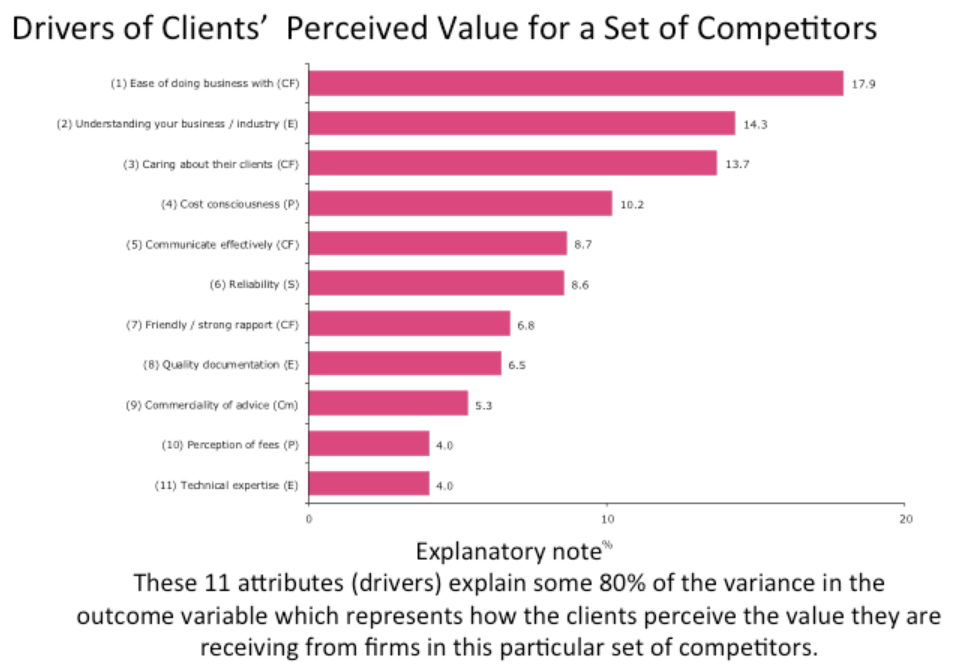
A firm and its practitioners will be rated well on cost consciousness if clients believe their money is being spent, in clients’ words, “as though the money being spent was the firm’s own”. Yet our research consistently shows the weakest link in managing clients’ perceptions of value is poor cost consciousness.
Check out this video, it is less than six minutes. Just before the two minute mark, Mr Sharp describes how Four Seasons is “selling value”. They are one of the leaders in luxury hotels worldwide and one of the most expensive. As he says, they led (not followed) the hotel/resort industry through $100, $200 … $1,000/night price points, because they provide value that people perceive and wish to pay for. In 2007, Bill Gates and a Saudi Arabian prince bought 95% of the company on a 50/50 basis, with Sharp owning the rest. You don’t get business partners like that unless you know what you are doing! In June, my spouse and I paid an astonishingly high amount to stay in a fabulous Four Seasons resort. We were happy to do so, because the overall experience/value warranted it. We are already dreaming about going back there and staying at other Four Seasons resorts elsewhere in the world.
Professional services firm leader
Paul hosted our third episode of 3in30.
Beaton Research + Consulting (‘beaton‘) is striving to be good citizens in how for ourselves we interpret and comply with the letter and spirit of privacy laws, including the General Data Protection Regulation (‘GDPR’). Accordingly, we are making the following statement of our position. We trust our example is helpful to you. This statement does not constitute advice or guidance.
The lawful basis upon which beaton collects information on our clients (e.g. name, email address, organisation) is our legitimate interest [Regulation (EU) 2016/679, Article 6(1)f] in collecting and using this information given there is “a relevant and appropriate relationship between the data subject and the controller in situations such as where the data subject is a client or in the service of the controller” [Recital 47] and processing this information helps us deliver better service to our (i.e. beaton’s) clients. We believe that using that personal data (i.e. email addresses) to collect client feedback constitutes processing for the same purpose, i.e. helping us deliver better service to our clients. Even if our use of the data was determined to be for a different purpose, we believe asking for feedback from our clients satisfies GDPR’s criteria for using collected personal data for a further compatible purpose [Article 6(4)], namely:
- There is a clear link between using these contact details to deliver service and using these contact details to ask for feedback on that service,
- The context of asking for evaluation of a service after having delivered it,
- That the personal data (i.e. name, email addresses, organisation) is not considered a special category,
- The only consequences would be potential minor annoyance at receiving a request-for-feedback email (to which clients can opt-out), and
- That we ensure appropriate safeguards are in place to protect that data (e.g. pseudonymisation, kept for no longer than is necessary).
To that end, we do not believe that we need consent to provide client data to a third party in order to get that feedback. It is in our legitimate interests to do so, provided we ensured the third party had all the relevant protections in place. Our Privacy Policy has been expanded and updated to make clear that we use third parties that meet the standards of GDPR [Article 46] and the Australian Privacy Principles. In the interests of transparency and accountability we may include in our Privacy Policy direct reference to some of the third party providers we may use to process personal data, even though we do not believe that is necessary under GDPR.
We will include explicit reference in our Privacy Policy [Articles 12, 13, 14] that we believe using personal data we have on our clients for research purposes is considered a legitimate interest in helping us deliver better service to our clients. We believe it not necessary to state this explicitly, because it is for the same purpose for which it was collected in the first place, but do so to be comprehensive.
We believe that making a comprehensive and easy-to-read Privacy Policy outlining all of the above available to all clients, and ensuring there are relevant safeguards in place with our third party providers, give us the right to provide personal data to third parties without the need for consent from our clients or making specific provisions in our terms of engagement with our clients.
To find out more about Beaton’s benchmarking products and how they can benefit your organisation please visit our Competitor benchmarking page or contact us to discuss your options with a Beaton partner.
Sign up for a free trial
You will get a survey just like a client would and then view your response in real-time on our interactive dashboard.
Achieving high NPS just became a whole lot easier
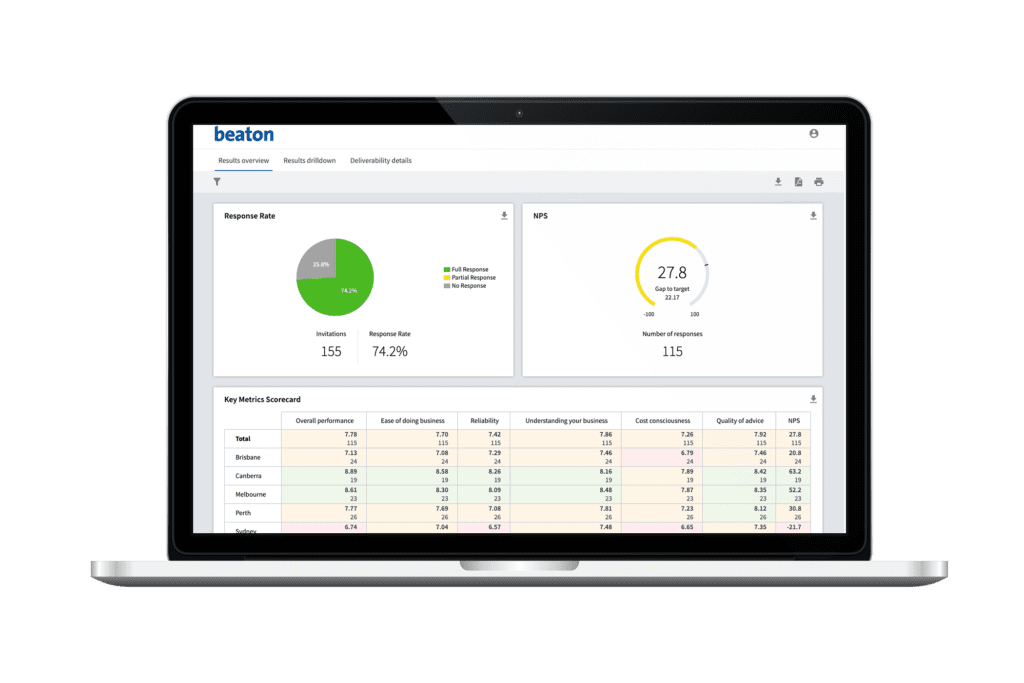
Use our platform, Beaton Debrief, to collect client feedback and act on it in real-time with our interactive dashboard. Sign up for a free trial today.
Regular client feedback at your fingertips
Use our platform, Beaton Debrief, to collect client feedback and act on it in real-time with our interactive dashboard. Sign up for a free trial today.
See how clients view your firm and where you stand against competitors
Participate for free in the largest, most comprehensive client sentiment industry benchmarking study in professional services.
Improve your trust and reputation with Beaton Benchmarks
Registration for Beaton Benchmarks is now open for a limited time. Participate for free in the largest, most comprehensive client sentiment industry benchmarking study in professional services.
Get insights and market trends delivered to your inbox
Sign up to our monthly newsletter and get the latest updates and insights from Beaton’s research.
Share these insights with a colleague
References
Dixon, M., Freeman, K., & Toman, N. (2010). Stop Trying to Delight Your Customers. In: Harvard Business Review, 88(7/8), 116-122.
Hayes, B. (2012, May 7). The Best Likelihood to Recommend Metric: Mean Score or Net Promoter Score? [Blog post]. Retrieved from: http://businessoverbroadway.com/the-best-likelihood-to-recommend-metric
Hayes, B. (2008). The True Test of Loyalty. In: Quality Progress, 41(6), 20-26.
Reichheld, F. (2003). The One Number You Need. In: Harvard Business Review, 81(12), 46-54.
Reichheld, F. (2006). The Ultimate Question. Driving Good Profits and True Growth. Boston: Harvard Business
Reichheld, F. (2006, July 27). Questions about NPS – and Some Answers [Blog post]. Retrieved from: http://netpromoter.typepad.com/fred_reichheld/2006/07/questions_about.html
Doorn, J.V., Leeflang, P.S.H., & Tijs, M. (2013). Satisfaction as a Predictor of Future Performance: A Replication. In: International Journal of Research in Marketing, 30(3), 314-318.